
DIY Indoor Plant Wall

I have this wall in my entryway that has been bothering me. The entryway itself is actually one of my favorite parts of the house, but this particular wall? Completely empty. Completely boring.

It’s a narrow wall with nothing on it but way too many switches. It gets amazing light and looks out onto the plant-filled atrium. And while that sounds dreamy (and it is), it still didn’t feel like enough greenery for me. I wanted more. I wanted a whole dang wall of plants.
Something simple though. Not a big shelf system. Not a bunch of planters and hanging pots. Not anything bulky or complicated. Just something minimal and a little magical…like ivy floating up the wall on an invisible trellis. Budget-friendly and pretty. So simple, right?
The good news is that I got what I wanted. The bad news is that I had to do this project twice to make that happen.

The first version was full of enthusiasm and poor planning. I didn’t find the studs, didn’t use anchors, and just screwed hooks directly into the drywall because, you know, they’re just plants. Then I used floral wire, which refused to stay tight…mostly because the second I pulled it, the hooks ripped out of the wall. The layout didn’t work around the light switches anyway, so I yanked it all down, patched every hole, and started over. Stronger. Wiser. Armed with a stud finder.
The second version? It worked. It’s sturdy, clean, and actually looks like the idea I had in my head (except for that part where I have to wait for it to grow in. So annoying).
How to Create an Invisible (ish) Plant Wall
Materials Needed –
- WallyGrow planters – You can use any planter, but I chose these because they sit off the floor and don’t steal the show.
- Wooden coat hooks with grooves – The grooves are key. I found simple ones on Amazon that had a little notch to help hold the fishing line in place. You’ll want a bunch so you can stagger them across the wall (I used four boxes).
- Fishing line – Clear, sturdy, and basically invisible once it’s up. This was a game changer after my failed attempt with floral wire.
- Tape Measure – Because “this looks about right” is a dangerous lie.
- Wall anchors – Don’t skip these (mine came with the hooks I purchased).
- Stud finder – Optional, but hitting as many studs as possible is always a good idea.
- Climbing plants – I used pothos because they are super easy to care for and propagate. Also, I’ve heard that if you let them climb instead of hang, the leaves get HUGE. I need to find out for myself.
Step-by-Step Instructions
Everyone’s living wall is going to look different, and that’s great. Make it work for you. Just follow these basic guidelines, and you’ll be obsessively cheering on each new leaf in no time.
1. Find the studs.
Use a stud finder and lightly mark where the studs are with a pencil. You’ll want to base your design around hitting as many as you can. This is key if you don’t want to redo the entire wall later. Ask me how I know.
2. Create your design.
You can arrange your hooks however you want. I did a 3-2-3 pattern (three hooks, then two, then three again), with each row spaced 10 inches apart.
3. Mark your hook placement
Use your tape measure and a pencil to mark where each hook will go. Be as precise as you can….you will likely need to do some math. I know, I’m sorry. I’m pissed about it too.
4. Add wall anchors where needed
Anywhere you’re not hitting a stud, you’ll need to use anchors. I recommend using the ones that came with your hooks, because they will be the right size (I’m not guaranteeing quality here). You may need to pre-drill, depending on the type you have. Either way, don’t skip this step unless you love watching things fall off your walls.
5. Screw in the hooks
Now that everything’s mapped out, go ahead and install your hooks. Don’t overtighten, especially if you’re using anchors.

7. Add the fishing line.
I started out trying to use floral wire. It was too visible, too bendy, and generally just… not it. Thankfully, my friends on Instagram came through and suggested fishing line. Of course I should have used fishing line. God bless a group project.
You can create any pattern you want here…zig-zag, diagonal, grid, whatever. Just make sure the line is pulled tight. It should sound like a guitar string when you pluck it (this is where hitting studs really pays off). Use the grooves in the hooks to hold the line in place, then tie off the ends so it stays taut and doesn’t sag over time.

8. Install the planters.
If your planters are sitting on the floor, easy. If they’re mounted, make sure they hit studs. Mine didn’t line up perfectly with the studs, so I added a 1×2 across the bottom of the wall, screwed it into three studs, painted it, and mounted the planters to that.

9. Add your plants.
Pop in your ivy, pothos, or whatever vining plants you love. If they’re already trailing, gently weave them through the fishing line to get them started on their upward journey.

10. Water and wait.
This is the hardest part. You’ll want instant jungle…something dramatic and overgrown by next week. Same. A few of my vines were long enough to wind up the wall right away, which gave me a little instant gratification. But for the most part? It’s a slow burn. Just water, wait, and resist the urge to measure growth with a ruler. It will fill in… eventually. Probably right when you stop checking.
Update: One Year Later
Y’all…it worked. It’s working. Look.
 June 2025
 September 2026
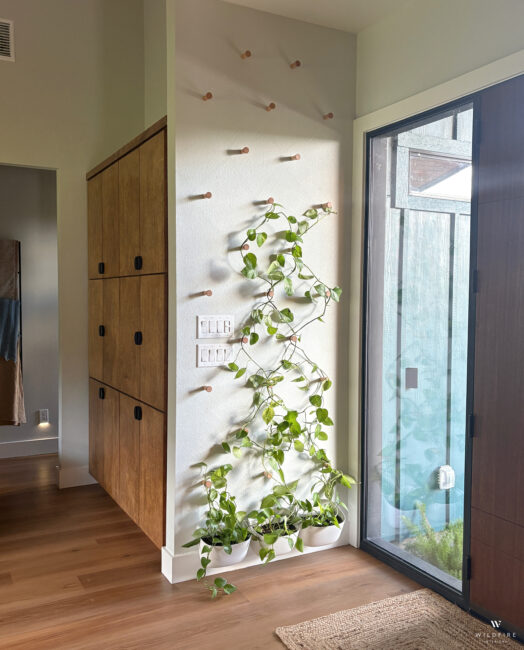
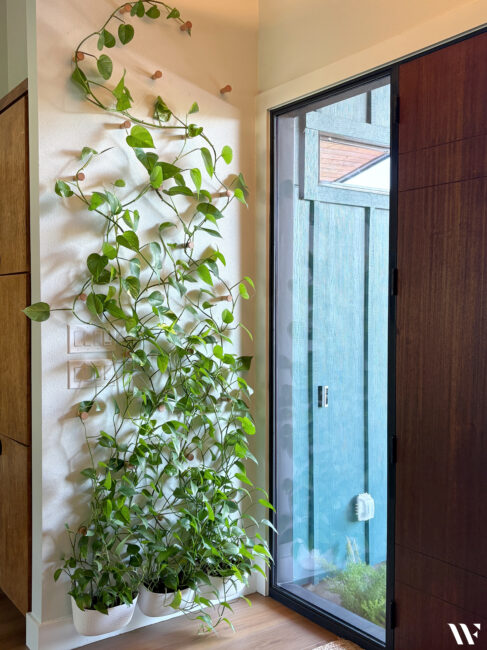
It grew to the ceiling very quickly, but looked thin and gross. So eight months after installing it, I chopped it way back, added those chopped-up bits right back into the soil, and waited. I water it when I remember (maybe twice a month?), but when I do, I add plant food, hydration renew, and soil refresh from Happy Happy Houseplant. The leaves are definitely getting bigger…the ones at the top are 2x-3x as big as the ones on the bottom, and some of the vines are nearly as thick as my pinky finger.
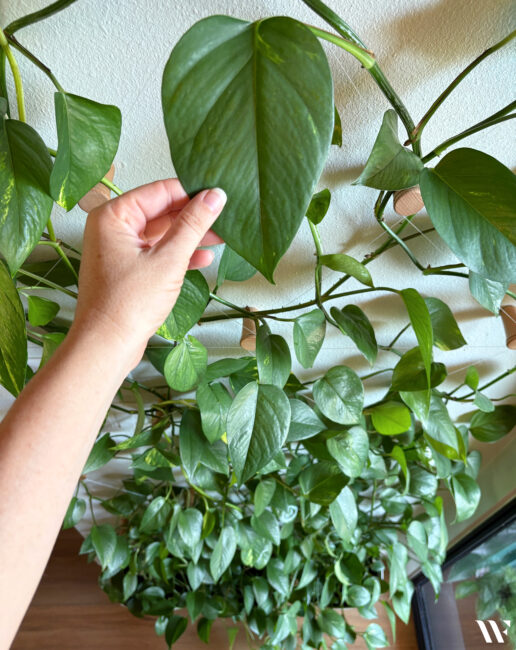
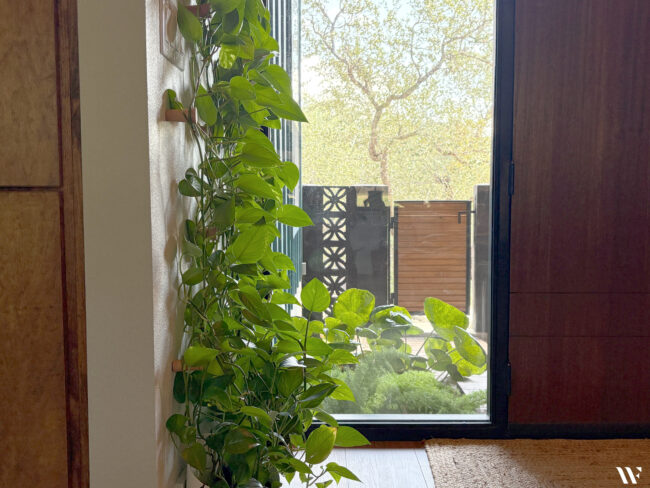
I really had no idea how this whole thing would turn out when I started, and I’m thrilled that it’s been successful (and I haven’t had to rip it out and patch 25 holes in the wall, again). Excited to see what kind of monster it is another year from now.
This looks super cool! I definitely want to try doing something like this somewhere in the house where the cat can’t nibble on the leaves, lol.
Yes, do it! Then we can cheer on new leaves together 🎉
I love this. But I also want to hear about the first attempt that didn’t go so well . . .
Ack, you’re right…I totally did not explain that very well! I’ll update the post. But basically, I didn’t preplan my design, find any studs, or use any anchors (because plants aren’t heavy). Then, when I tried to add tension, they came right out of the wall…so I patched everything and started from scratch.
This plant wall is such an inspiring way to bring nature indoors it’s both functional and beautifully decorative. I love how it transforms blank walls into lush, living art!